
The Storied Cry (2)
the ghost hovers above the table

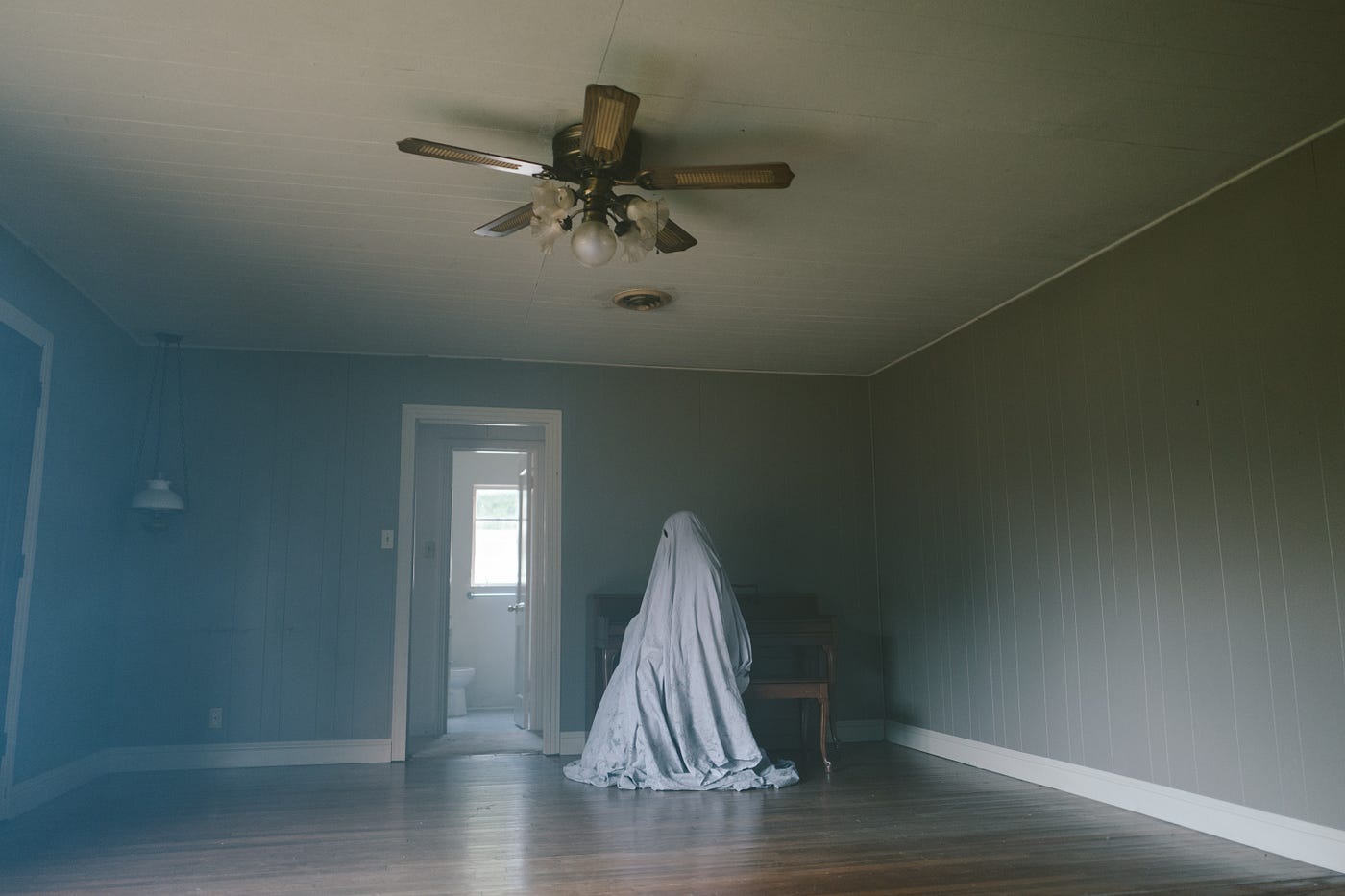
Will Oldham, known musically as Bonnie ‘Prince’ Billy, performs the “Prognosticator” in David Lowery’s 2017 film A Ghost Story. When viewers meet him, he sits at the kitchen table in a house we’ve seen before, however much it’s changed from the camera’s first vision of it. A long-ish, ranchy thing within suburban distance from Dallas, the house seems to waver over the ground, as if trying to disappear. Given its copies on either side, slightly elevated from the soil to resist descending into dirt, the house dates to the 1950s, when everything boomed or anticipated booming. After a cluster of years from this moment, the city will encroach with its need for more high rent building space, demolishing any house whose inhabitants longed for a homestead, any object standing before that need’s achievement.
But so much here concerns the downward glide into disappearing.
The film’s lead couple, embodied by Rooney Mara and Casey Affleck, their names withheld from us, even if the credits identify them as M and C, begin to split apart. She knows herself according to her capacity to move, to her yearning for the words that her partner can’t wrestle with himself to give. He sits at the controls of their living room’s makeshift studio, laboring at a song whose ache he can sing out but not explain, surrounded by the house he won’t animate himself to part with. We get the attachment but not its cause, just as we get the sight of him, one early morning, dead inside his car before their driveway, the thing cracked open, a bracelet of mist coiled around the whole, the scene denying us proximity to how the cracking happened.
M takes her mourning with her, and the house enters into a period of revolving tenants, leading us to this late night domestic rave, the volume pushed up, the bass blasting down, when Oldham clasps his beer bottle, his mouth widened by a prophecy that no one wants to hear.
He describes how our kind will rocket to the moon or Mars, conquering, taming its turf in the face of a climate disaster there can be no way of coming back from. He muses on Bach and Beethoven, hums the Ninth Symphony’s famous tune to a joy-spreading freedom that even the uninformed must know, while its maker’s name remains distant from them, the sequence of notes valued, he says, for the eternal sketched out by their shape, for how that sequence attaches to human memory and balks at time’s bulky incitements to forget.
So, the power to be remembered manifests our skills at their apex and means that what stands for us will always negate our end. But with the heap of decimated CDs and musical scores and instruments behind us, who will recall the soar of Beethoven’s melody? It will vanish into that eternity it was once made to take the place of.
Shouting now, he asserts to the raving dancers that each of their children will die in an answer to their own deaths, that losing is the only fact, that the concept of unending could never support everything forced to stand upon it. Yet the “Prognosticator” can’t see how the loss he leans into replaces—in its noisy certitude—the conceptualizing he still rages against; he can’t see the camera as it veers from his face, revealing C’s sheeted figure, the ghost at the center of the film’s title, its eyes blackened ovals, the long, pleated thing that rose from a table in the morgue to return to the house that he, or it, didn’t know how to leave.
C raises what must be an arm, the lights blink, fizzle, the music cuts off, and the lamp above the kitchen table sways in a wide arc, batted by a cause that won’t be reasoned out of the room.
I notice that my work here marches around questions: how can those of us who care, who might learn to care, safeguard the lyricism sonically rising up from a self, beyond explication; how can we foster the heart of a loved one that will or won’t go on pulsing, regardless of our attentions to that sound; what can each of us make of the doubt that surely follows every life? To think on these, I turn to my own cries, ones that trail me in the classroom, as I teach writing to students who hope to settle into their four years at New York University.
I live in a country with a deadening at its core, among the Twitter-drone of a president who professes that women are there for the grabbing, or they’re not, that the options to grab and its negative are supported by the paper currency of his power that underwrites his ability to dismiss, or to inadequately recognize, whole categories of persons: transgender members of the military; the bodies so other than his own, whether in Puerto Rico under the ravaging of Hurricane Maria and the federal assistance that neglected to show, or on southern streets, on northern sidewalks, brown flesh battered by policemen ill-trained to see, or to empathize with, anything in addition to their own reflections.
But this emphasis on the fiat of individual force and its dismissals becomes a sound too easily echoed by those ready to replicate it. An Attorney General who argues that Title VII of 1964’s Civil Rights Act won’t prohibit discrimination based on gender-identity, that lovers of the same sex will, under law, be vulnerable to the intolerance of others, even as the highest court confirms our right to marry. A Secretary of Education who has yet to organize a single, vigilant policy before the vision of students shot down in schools meant to assist them in imagining the range of a life, in a country requiring more range than it knows how, at the moment, to accept. I think of Mary Beard’s 2017 Women and Power, where she counters the latter term’s liability to being treated as “something elite, coupled to public prestige, to the individual charisma of so-called ‘leadership,’ and often, though not always, to a degree of celebrity.” She opposes such an image of power by maintaining that you can’t “easily fit women into a structure that is already coded as male; you have to change the structure. That means thinking about power differently. It means decoupling it from public prestige. It means thinking collaboratively, about the power of followers not just of leaders.” Over everything, it means “thinking about power as an attribute or even as a verb . . . not as a possession.”
I think of Alan Dent’s preamble to the poet Martin Hayes’ rageful song of a book, The Things Our Hands Once Stood For, where he acknowledges that “employment is a demeaning subject because employment is demeaning,” with overseers clicked into a system preparing them to comprehend each human worker as identical with the function delegated to him. I hear Hayes rail, “never give up fighting / until the day we die / because that was exactly what they wanted us to do,” because the railing was to be expected—and discounted.
All this sticks to the air in the rooms I share with my students. For some, it weighs heavily, for others, not at all. I’m not interested in foisting on students the obligation to transform a structure or to adhere to one perspective. I’m devoted to helping them to see that the structures are there and that they can turn to words to face them.
But I’ve lived enough to recall, to reflect on, my undergraduate musical education in Boston, where teachers (well-meaning, a little tired) mingled their voices together in a chorus to maintain that we penciled in the eighth and sixteenth notes of our scores, we coaxed artful croons from pianos, saxophones, and violins in a sealed space, haloed by its separation from the buzz and hazards of the streets outside, with their crazy, overpeopled geometries. I see my then-contemporary, Rachel, so attached to the box of her practice room and its shut door that she’ll play for 15 hours daily, forgetting to eat, forgetting to nurture the body that allows her to plunk out sound at all, her hands a flutter of bones over piano keys obedient to her need of them. I was a student locked in the chug-chug of a stutter, my mouth a locomotion of consonants never reaching the right place, though that faltering had an upturn: it pushed me into the world that our teachers schooled all of us to berate.
In the mid-1980s, I took my music on a tour through England, Scotland, and France, at the mercy of pianos in rented halls, on the thickening edge of a plague that would knife the lives of the men I loved. Reagan in the White House busied himself with not enunciating the name of that scourge, and men with fury in their faces stopped me on train platforms, yelling “AIDS victim” at my face, equating me with a wrecking that I was strangely, somehow, saved from.
I look on versions of the past that our current President hoists up as something to fold back into, the struggle to “make America great again” chastened by years whose policies and practices were often more unloving, more heart-dead, than what any greatness should lay claim to. I say yes to poet Edna St. Vincent Millay’s contention, in 1950, that the “trained hand does not forget” the bodily encoded memory of its “skill.” But I worry about the courage pressed on those who refuse to trot out skill sets and employ them in well-worn ways, who deny remaking the past and the more than occasional injustice of its flaws. I hear voices of men and women who stand by the compulsion to go back, though I know that the going back will never be a way of stepping onward.
All these concerns walk with me into the classroom as my students and I greet each other. I remain quiet about them. They’re ghosts that blur in a clutch behind every word that we read, say, write. But those words aim out, beyond the page, beyond the desk, and through the window.
We do, too.
Beautiful and powerful words! ❤️ Thank you writing this and naming with such care and courage ❤️❤️❤️
sentences like waves at the shoreline, lapping, retreating, cresting far out to sea, drawing us into their depth and roll