The Storied Cry (3)
thinking the cry

Patricio Guzmán’s 2011 documentary, Nostalgia for the Light, glances back at time according to varying scales of measurement. There’s the arid air that the camera makes available to viewers of Chile’s Atacama Desert, which, like all sun-stoked places, takes what it can get and clasps—hard. It scavenges the bits of once animate life that belonged to those who clung to them when whole, stratifying the residue of fishermen who plunged into abundant water 7,000 years before that child who was Jesus, his advent drawing the threshold between before and after his incarnation, only to deposit everything that followed in granular heaps of time.
Alongside archeologists from the nation’s universities, sisters and mothers of those whom Augusto Pinochet’s regime “disappeared,” or threw away, because they rejected his taking of the state, are scraping at the ground with spades.
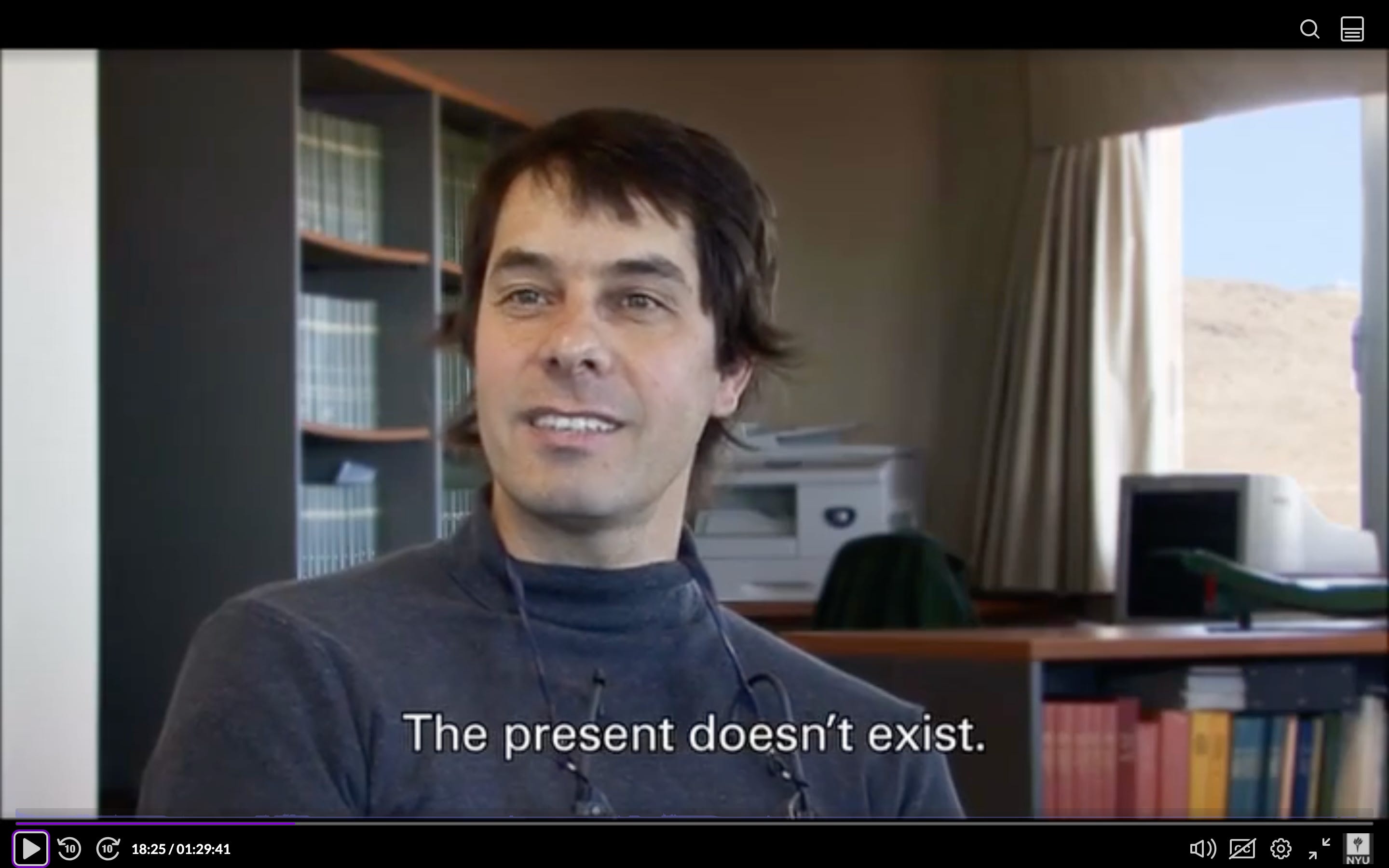
They look for pieces of the ones they loved because the granules must give them back, though the military assures all who listen that the bodies were hurled into the sea and lost there. But what the women find over the course of filming, a severed foot, a face split open, belies that assurance. Above the spading women, the telescopes of ALMA’s international complex direct their perfect circles at the celestial picture of events long over, given the distance between their signals and the astronomers who mark that gap. So many assurances are undone here, ones beloved by my students with their phones and Twitter feeds and selfies, trumpeting the moment that never seems to end: astrophysicist Gaspar Galaz, from his office within sight of ALMA’s telescopes, responds to Guzmán’s query about the present.
He points at the camera we can’t see, says that its standing a few meters away from him means that this conversation is already in the past, that we don’t recognize anything in the instant that we look at it, how the trap is to think otherwise, since any signal takes time to travel and to be answered. Yet the upside of this lag tells us that the power to reflect is made room for by our experience of each moment-to-moment. And that room should be taken.
If the prodded cry occurs before the story that we form of it, what precedes the rising up of sound lies encrypted there. Those of us who bother to unspool its instructions can critique them, in what loose language permits me to call the present, as we flick through the past adjacent to it. The millionth of a second lapse can be an aid to hearing how pastness seems to want to speak to us.
I’m recalling David Lowery’s “Prognosticator” from A Ghost Story and how his bemoaning forecast really asks: if everything is always (already) over, why do anything at all?
I’ve taught many of the old books that raise up eternity in contrast to flux, applying their associated values to the sexes that differentiate what we are. The men behind these words customarily wrote them at the cost of women whose bodies were their originators. Siri Hustvedt and 2016’s A Woman Looking at Men Looking at Women remind us that “human beings are the only animals who kill for ideas, so it is wise to take them seriously, wise to ask what they are and how they came about,” seeing that all “ideas are in one way or another received ideas,” however adapted or maladapted over time. In the 4th century before our Common Era, Aristotle’s Generation of Animals seized, hard, on the idea that “male and female are the first principles” of “soul and body,” and “they will exist in those things that possess them for the sake of generation.” But, “as the [masculine] or efficient moving cause, to which belong the definition and the form, is better and more divine in nature than the [feminine] material on which it works,” the “superior should be separated from the inferior,” at least in terms of value. Because “the first principle of the [generating] movement, whereby that which comes into being is male, is better and more divine, and the female is the matter,” the “soul” must be held high over “body” and its inability to say no to the flux of time’s devastations.
Hustvedt underscores how, when “ancient philosophy” and “Aristotle in particular” were “revived in the West by Islamic thinkers,” then “retranslated from Arabic into Latin in the twelfth century,” these “old ideas breathed with new life,” reverberating “over the centuries” and refusing to die, as if miming the gendered soul that was their crux.
But “old ideas” don’t disappoint death on their own.
Their continued life needs to be fought for by those who legislate the rigidity at their center, in approaches to governance that calibrate which bodies are worthy and unworthy, which should walk free and which deserve enslavement because of their fellowship with feminine “matter” that persists only to be worked on—or, at this moment, which children must be disunited from their migrating families and encaged, made into the wrong bodies at the wrong border, struggling for asylum in the wrong country.
Yet the “representation” of thought fundamental to all word-gathering, legal or otherwise, Hustvedt stresses, is “by its very nature . . . estranged from what is being represented. In speech and writing we alienate ourselves from ourselves even when we say ‘I’ to include the self as speaker.” The interval attendant on that making-strange, this self-othering, ought to issue in the power of any word-user to reflect on the ramifications of what he intended to utter and to enforce. With Hustvedt, we may approve the idea that in “the beginning there is an organism of blood and muscle and flesh and bone and, if all goes well, it will eventually say ‘I’ to a ‘you.’” Yes, “it will spin narratives and be spun by them,” but each of us is responsible for the character of that spinning, which deserves watchful judgment, the kind that generates more life than it nullifies and will soon destroy.
Answering to how ideas need to be accounted for remains much of what the essay as a form teaches its writers, readers, students, instructors. That’s why any classroom can be a waking place.